ONE:But this prosperity lay only on the surface, and scarcely even there or anywhere but in the pride and lying assertions of Buonaparte. If we contemplate merely the map of Europe, the mighty expanse of the French empire seemed to occupy nearly the whole of it, and to offer an awful spectacle of one man's power. This empire, so rapidly erected, had absorbed Holland, Belgium, part of Switzerland¡ªfor the Valais was united to France,¡ªa considerable part of Germany, with Austria and Prussia diminished and trembling at the haughty usurper. Italy was also made part of the great French realm, and a fierce struggle was going on for the incorporation of Spain and Portugal. From Travemünde on the Baltic to the foot of the Pyrenees, from the port of Brest to Terracina on the confines of Neapolitan territory, north and south, east and west, extended this gigantic empire. Eight hundred thousand square miles, containing eighty-five millions of people, were either the direct subjects or the vassals of France. The survey was enough to inflate the pride of the conqueror, who had begun his wonderful career as a lieutenant of artillery. But this vast dominion had been compacted by too much violence, and in outrage to too many human interests, to remain united, or to possess real strength, even for the present. The elements of dissolution were already actively at work in it. The enormous drafts of men to supply the wars by which the empire had been created had terribly exhausted France. This drain, still kept up by the obstinate resistance of Spain and Portugal, necessitated conscription on conscription, and this on the most enormous scale. The young men were annually dragged from the towns, villages, and fields, from amid their weeping and despairing relatives, to recruit the profuse destruction in the armies, and there scarcely remained, all over France, any but mere boys to continue the trade and agriculture of the country, assisted by old men, and women. Beyond the boundaries of France, the populations of subdued and insulted nations were watching for the opportunity to rise and resume their rights. In Germany they were encouraging each other to prepare for the day of retribution; and in numerous places along the coasts bands of smugglers kept up a continual warfare with the French officers of the customs, to introduce British manufactures. The contributions which had been levied in Holland and the Hanse Towns before they were incorporated in the Gallic empire were now not readily collected in the shape of taxes. Beyond the Continent ceased the power of Napoleon; over all seas and colonies reigned his invincible enemy, Great Britain. There was scarcely a spot the wide world over where the French flag, or those of the nations whom he had crushed into an odious alliance, waved on which Great Britain had not now planted her colours. She cut off all colonial supplies, except what she secretly sold to his subjects in defiance of his system. She was now victoriously bearing up his enemies in Spain,[21] Portugal, and Sicily against him, and encouraging Russia, Sweden, Prussia, and Austria to expect the day of his final overthrow. There was scarcely a man of any penetration who expected that this vast and unwieldy government could continue to exist a single day after him who had compelled it into union, rather than life; but, perhaps, none suspected how suddenly it would collapse. Yet the very birth of a son was rather calculated to undermine than to perpetuate it. His great generals, who had risen as he had risen, were suspected of looking forward, like those of Alexander of Macedon, to each seizing a kingdom for himself when the chief marauder should fall. It was certain that they had long been at enmity amongst themselves¡ªa cause of weakness to his military operations, which was especially marked in Spain.
ONE:Thus shamefully deserted on both hands, Cumberland still led forward his British and Hanoverians against the main body of the French army. The ruggedness of the ground in the[91] narrow valley between the wood of Barr¨¦ and Fontenoy compelled them to leave the cavalry behind; but the infantry pushed on, dragging with them several pieces of artillery. Cumberland had the advantage of the advice and spirit of his military tutor, General Ligonier, and, in face of a most murderous fire, the young commander hastened on. The batteries right and left mowed them down, and before this comparative handful of men stood massed the vast French army, in a position pronounced by the French impregnable. The dense column of the English, compressed between the wood of Barr¨¦ and Fontenoy, soon drove the French from their positions, and, still pushing on towards the rear of Fontenoy, threatened to cut off the bridge of Calonne, and with it the enemy's retreat across the river. Both French and English conceived that the battle was decided for the Allies. Marshal K?nigsegg congratulated Cumberland on their victory, and, on the other hand, Saxe warned Louis XV. that it was necessary to retreat. Louis, however, is said to have protested against giving way, and both French and English soon became aware that the Dutch had deserted their post, and that the right wing of the French army remained wholly unengaged. The British and Hanoverian conquerors on their right, when they mounted the French positions, looked out for their left wing, the Dutch, and, to their dismay, beheld them hanging with cowardly inactivity in the distance. The brave Marshal Saxe, at the same moment making the same discovery, called forward the Household Troops, which had been posted to receive the Dutch, and precipitated them on the flank of the British. Foremost in this charge was the Irish Brigade, in the pay of France, who fought like furies against their countrymen. Overwhelmed by numbers, and numbers perfectly fresh, and mowed down by additional artillery which the default of the Dutch had set at liberty, and unsupported by their own cavalry from the confined and rugged nature of the ground, the brave British and Hanoverians were compelled to give way. But they did it in such order and steadiness, disputing every inch of the ground, as excited the admiration of their opponents. The Duke of Cumberland was the last in the retreat, still regardless of his own danger, calling on his men to remember Blenheim and Ramillies; and seeing one of his officers turning to flee, he threatened to shoot him. Thus they gave way slowly, and still fighting, till they reached their horse, which then made a front to cover them, till they were out of the m¨ºl¨¦e; their dastardly allies, the Dutch, then joined them, and they marched away in a body to Ath. Tournay, for which the battle was fought, might have detained the French a long time; but here, again, Dutch treachery did its work. Hertsall, the chief engineer in the Dutch service, betrayed the place to the French, fled to their camp, and then assisted them by his advice. Tournay surrendered in a fortnight, and the citadel the week after. Ghent, Bruges, Oudenarde, and Dendermond fell in rapid succession. Whilst the Allies were covering Antwerp and Brussels, the French attacked and took Ostend, again by the treachery of the governor, who refused to inundate the country.Painting, like architecture, was at a very low ebb during this period, with one or two brilliant exceptions. Foreign artists were in demand, and there was no native talent, except that of Thornhill and Hogarth, which could claim to be unjustly overlooked in that preference. Sir Peter Lely was still living, but Sir Godfrey Kneller, another foreigner, was already taking his place. Kneller was a German, born at Lübeck, and educated under the best Flemish masters of the day. As he had chosen portrait-painting as his department, he hastened over to England after a visit to Rome and Venice, as the most profitable field for his practice, and being introduced to Charles II. by the Duke of Monmouth, he became at once the fashion. Kneller had talents of the highest order, and, had not his passion for money-making been still greater, he would have taken rank with the great masters; but, having painted a few truly fine pictures, he relied on them to secure his fame, and commenced an actual manufacture of portraits for the accumulation of money. Like Rubens, he sketched out the main figure, and painted the head and face, leaving his pupils to fill in all the rest. He worked with wonderful rapidity, and had figures often prepared beforehand, on which he fitted heads as they were commissioned. Sir John Medina, a Fleming, was the chief manufacturer of ready-made figures and postures for him, the rest filled in the draperies and backgrounds. Kneller had a bold, free, and vigorous hand, painting with wonderful rapidity, and much of the grace of Vandyck, but only a few of his works show what he was capable of. The beauties of the Court of William and Mary, which may be seen side by side with those of the Court of Charles II. by Lely at Hampton Court, are far inferior to Lely's.
TWO:
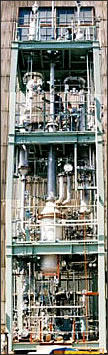
High quality is being demanded in many fields nowadays and so in order to satisfy that we developed a high-purity distillation system in collaboration with Ube industries, Ltd. and Kanto Chemical Co., Inc. The system is used to refine cleaning solutions for the semiconductor industry, medical materials, etc. of high purity (residual ion concentration: 0.01 to 1.0 ppb).
THREE:On the retirement of Townshend, Walpole reigned supreme and without a rival in the Cabinet. Henry Pelham was made Secretary at War; Compton Earl of Wilmington Privy Seal. He left foreign affairs chiefly to Stanhope, now Lord Harrington, and to the Duke of Newcastle, impressing on them by all means to avoid quarrels with foreign Powers, and maintain the blessings of peace. With all the faults of Walpole, this was the praise of his political system, which system, on the meeting of Parliament in the spring of 1731, was violently attacked by Wyndham and Pulteney, on the plea that we were making ruinous treaties, and sacrificing British interests, in order to benefit Hanover, the eternal millstone round the neck of England. Pulteney and Bolingbroke carried the same attack into the pages of The Craftsman, but they failed to move Walpole, or to shake his power.
Our High-purity distillation system provide our clients with high solvent recovery rate, almost 100%.
The quality of the products/output from our system is very stable, which makes production management very easy, and easier than the conventional ion exchange resin method.
No emission of waste brings our clients reduction of running cost for environmental measures.
Our various devices minimize entrainment.
To prevent the elution of metal, you could ask us the system made of Teflon.
Our High-purity distillation system has been already proved for solvents that trigger very rapid decomposition reactions, such as hydrogen peroxide.